PPC and paid ads
PPC keyword research: a step-by-step process that finds buyers

Key takeaways
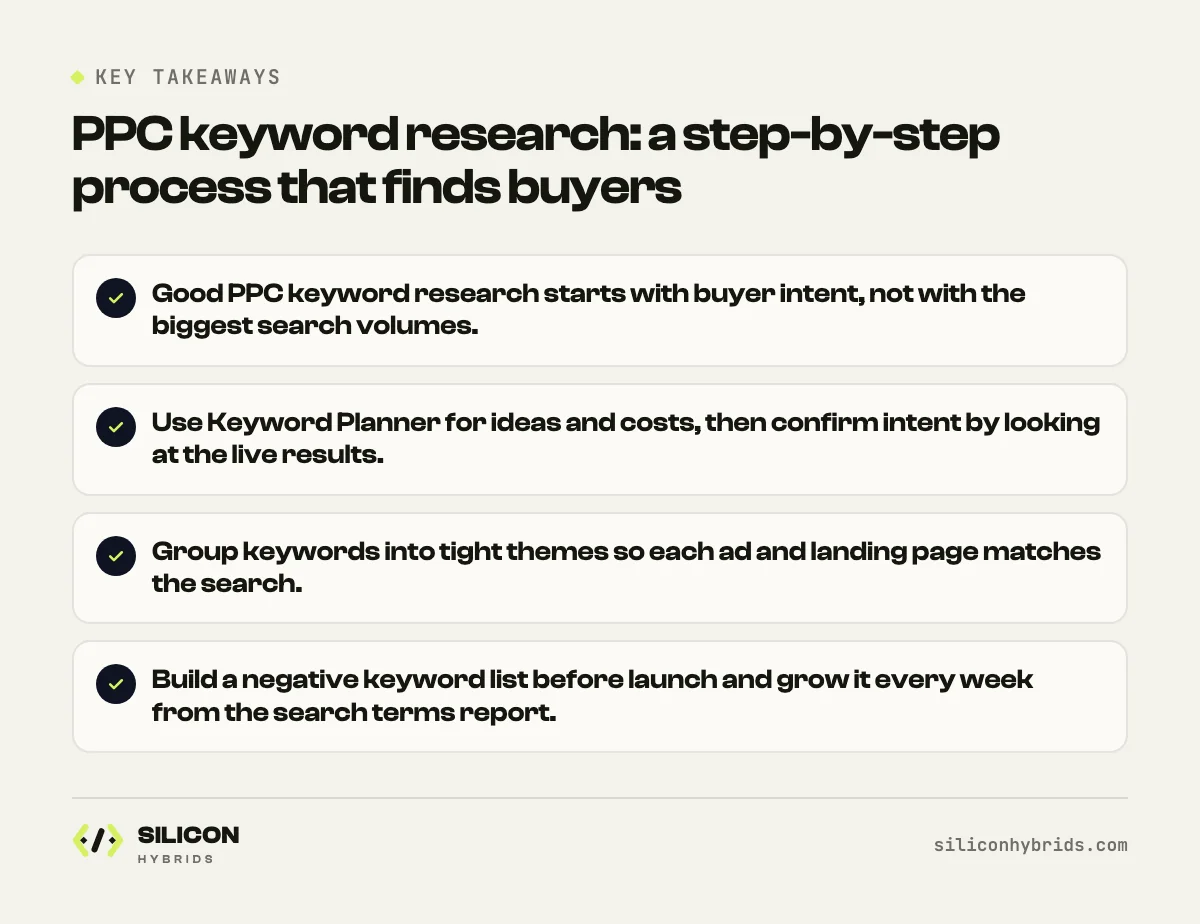
- Good PPC keyword research starts with buyer intent, not with the biggest search volumes.
- Use Keyword Planner for ideas and costs, then confirm intent by looking at the live results.
- Group keywords into tight themes so each ad and landing page matches the search.
- Build a negative keyword list before launch and grow it every week from the search terms report.
Your keywords decide who sees your ads, so PPC keyword research is where most of the money in a campaign is won or lost. Pick searches with real buying intent and a modest budget can bring steady leads. Pick broad, curious searches and even a large budget disappears into clicks that never call.
This is the process we use for new Google Ads accounts. It works for any business and needs only free tools to start.
Start with intent, not volume
Every search has an intent behind it. For PPC, the most valuable searches are the ones closest to a purchase. Sort ideas into four groups before you look at a single number:
| Intent | Example | Use in PPC |
|---|---|---|
| Transactional | book emergency plumber denver | Highest priority, bid strongly |
| Commercial | best plumbing company denver reviews | Good, often worth bidding |
| Informational | why is my pipe banging | Usually leave to SEO and content |
| Navigational | a competitor brand name | Only with a clear plan |
A keyword with 50 searches a month and clear buying intent often beats one with 5,000 searches from people who are only curious.
PPC keyword research in 7 steps

- List your services and locations. Write down every service you want leads for and every area you serve. These are your seed keywords.
- Expand with Keyword Planner. Enter your seeds into Google Keyword Planner to see related searches, monthly volumes and top-of-page bid ranges.
- Add modifiers that signal buying. Words like "near me", "cost", "quote", "same day", "emergency" and "hire" usually mean someone is ready to act.
- Check the live results. Search the main terms yourself. If the results are full of guides and videos, the intent is informational. If they show ads and service pages, buyers are searching.
- Learn from competitors. A PPC competitor analysis shows which terms rivals have bid on for months, which is a good sign they convert.
- Group into tight themes. Put closely related keywords in the same ad group so the ad and landing page can match them exactly.
- Build your negative list. Exclude searches you never want to pay for before the campaign goes live.
How to group keywords into ad groups
Tight grouping is what makes your ads relevant. Relevant ads earn a better Quality Score, which can lower your cost per click. A simple rule: if two keywords would need a different headline to feel like a perfect answer, they belong in different ad groups.
- Ad group: emergency plumber. emergency plumber, 24 hour plumber, plumber open now.
- Ad group: water heater repair. water heater repair, hot water heater not working, water heater replacement.
- Ad group: drain cleaning. drain cleaning, blocked drain, clogged drain service.
Each group then gets its own ad and, ideally, its own landing page. Our guide to how PPC works explains why this matters for Ad Rank.
Choosing match types
For new accounts with small budgets, start with exact and phrase match on your best keywords. They keep spend on the searches you chose. Broad match can find more volume, but it works best once the account has solid conversion tracking and enough data for smart bidding to learn from.
Build a negative keyword list from day one
Negative keywords stop your ads showing for searches that will never buy. Start with these common groups and add your own:
| Negative group | Examples | Why |
|---|---|---|
| Jobs and careers | jobs, hiring, salary, career | People looking for work, not a service |
| Training | course, training, how to become | Learners, not buyers |
| Free and DIY | free, diy, yourself | Not looking to pay |
| Wrong locations | towns you do not serve | Leads you cannot take |
| Wrong services | services you do not offer | Wasted clicks |
After launch, open the search terms report every week. It shows the real searches that triggered your ads. Add new negatives and promote the good surprises to keywords.
How many keywords should you start with?
Fewer than you think. A focused campaign with 20 to 50 strong keywords, split into five to ten ad groups, usually beats a sprawling list of hundreds. With a small budget, too many keywords spread your spend so thin that no single ad group gets enough data to learn from. Start narrow, prove what converts, then expand.
PPC keyword research tools compared
| Tool | Strength | Cost |
|---|---|---|
| Google Keyword Planner | Google volumes and bid ranges | Free with an Ads account |
| Search terms report | Real searches from your own ads | Free in Google Ads |
| Microsoft Ads keyword planner | Bing volumes and costs | Free with an account |
| Semrush or Ahrefs | Competitor keywords and trends | Paid |
For most small accounts, Keyword Planner plus your own search terms report is enough. Paid tools earn their cost when you manage several accounts or compete in crowded markets.
A worked example: a dental clinic
Imagine a dental clinic that wants more implant and emergency appointments. Seeds would be "dental implants", "emergency dentist" and the clinic's town. Keyword Planner suggests "dental implants cost", "same day emergency dentist" and "dentist open saturday". Checking the live results shows "dental implants cost" brings guides as well as clinics, so it goes into its own ad group with a pricing-focused page. "Emergency dentist near me" becomes the highest priority group. Negatives include "dental school", "dentist jobs" and "free dental care". The result is three tight ad groups instead of one broad list, each with its own ad and landing page.
Summary
In short: start with buyer intent, expand with Keyword Planner, check the live results, group keywords tightly and build a negative list before launch. Review search terms every week after that.
Common PPC keyword research mistakes
- Chasing volume. High-volume terms are often broad and expensive.
- One giant ad group. Mixed keywords mean generic ads and lower Quality Scores.
- No negatives. The fastest way to waste a budget.
- Never revisiting the list. Search behaviour changes. Review keywords monthly.
Keyword research for PPC also feeds SEO: terms that convert in ads are strong candidates for organic pages, as we explain in SEO vs PPC. If you want the research and build done for you, see our Google Ads management.
Frequently asked questions
What is the best free tool for PPC keyword research?
Google Keyword Planner is the best free starting point, because it shows Google search volumes and bid ranges. Your own search terms report becomes even more valuable once ads are running.
How do I find keywords with buying intent?
Look for words that signal action, such as cost, quote, near me, hire, book and same day, and check the live results to confirm they show ads and service pages.
What is a negative keyword?
A negative keyword stops your ad from showing when a search contains that word. It is how you avoid paying for clicks from people who will never buy.
Should I bid on broad keywords?
Broad keywords bring volume but often less intent and higher cost. Start with specific, high-intent keywords and add broader ones once tracking shows what converts.
How often should I update my keyword list?
Check the search terms report weekly and review the full keyword list monthly, adding negatives and promoting new converting searches.
How many keywords should a PPC ad group have?
Usually a small, closely related set, often between 5 and 20. If keywords need different headlines to match well, split them into separate ad groups.
Should I use the same keywords for PPC and SEO?
Often yes. Keywords that convert in PPC are strong candidates for SEO pages, and SEO data can suggest new PPC keywords.
What is the difference between PPC and SEO keyword research?
PPC keyword research focuses on buying intent and cost, because you pay for every click. SEO keyword research also values informational searches that build traffic over time.
How do I find long-tail keywords for PPC?
Use Keyword Planner suggestions, your search terms report and the People also ask box. Long-tail keywords are specific, cheaper and often convert well.
Should I bid on my own brand name?
Usually yes. Brand campaigns are cheap and protect your name from competitors who bid on it.
Keywords that convert
Want your keyword list built and tested?
Send one real task, like a keyword plan for one service, and we will deliver it free.